Saturday, December 25, 2010


                         THE  FAMOUS FESTIVAL  OF SARKARA - KAALIYOOT
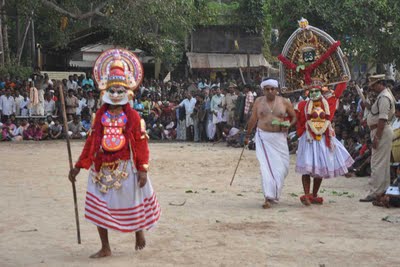


Each temple in kerala has its own Utsavam (festivals) which forms the fourth important activity of any great temple. The number and size of the festivals depends on the fame and wealth of the temple. Some of the temples of minor importance have only one festival and the number of days on which it is celebrated will be limited. In Sarkaradevi temple, which attracts large number of pilgrims and has its own sources of income, the celebrations are on a large scale and are spread over several days. The chief Utsavam in the temple is the festival of kaliyoot, which false on the Malayalam month of kumbham (March).
Kali, the Mother of Goddess is the deity of farmers. It is evident from the inclusion of the fictitious interpretations of agricultural art traditions in the rituals of the art form of Kaliyoot. Kaliyoot is the dramatic presentation of the genesis of Bhadrakali and Darika the representatives of good and evil respectively, their confrontation and later the extermination of Darika in devotional terms and with rhythmic footsteps.
The fact that the Kaliyoot is a synthesis of older agrarian art tradition is  further established by  the time chosen for performing Kaliyoot after Makara Koithu (the Malayalam month of Makaram corresponds to March and in the season of the second harvest season in kerala. Koithu is a Malayalam term for harvest ) and that Kali appears under the guise of a pulaya (the pulaya caste is the traditional agricultural labouring community in Kerala.) girl in the Kali drama.
The object of Kaliyoot festival is to offer the elementary harvest to the Amma (the divine Mother), the defender of the land.
The ritual art of Kaliyoot was originally celebrated in North Malabar to propitiate Goddess Kali was brought to Travancore and that too to the Sarkara Temple by King Marthanda Varma (1729 - 1758). There is a historical legend connected with it.

For expanding the domain of this kingdom, Marthanda Varma Maharaja tried to capture kayamkulam province several times.(A.P. Ibrahim Kunju, Rise of Travancore, A study of the Life and Times of Marthanda Varma (Trivandrum:1976 ). All his efforts were in vain and he felt disappointed. But he did not give away his ambition. His one and only motive was the defeat of  Kayamkulam Raja. With the unyielding desire he was forced to make another arrangement for a war. On his way to Kayamkulam it is said that he chose the big ground near the Sarkara temple to take rest.
Learning the arrival of Maharaja in their mace, that leaders of the place or Karakkar and Kalarigurukkals (The grand teachers of military techniques at the Kalari.) assembled together to have a glimpse of the Maharaja. Hearing the Raja's stories of defeat at Kayamkulam, they suggested that the only way to his triumph was to offer a Kaliyoot to Sarkaradevi. In conformity with their suggestion the Maharaja decided to offer Kaliyoot to Sarkaradevi.

Rituals and ceremonies connected in nine-day performance related to Kaliyoot

It is believed that there is a basic text titled Kaliyoot Mahathmyam (It is said that the text composed by Kannassa Panicker.) authored by Kannasa Panicker ceremonies connected with Kaliyoot as a devotional offering.
After the construction of the stage for the chief performance the pernu and the invoking of the spirit of the Goddess into lamps, the chief rites of the first days begin.

The rites of 1st Day

Kurikurikkal and Vellattam are conducted in the first day of Kaliyoot festival. It is a function which arises a question, is that how much money and rice were collected for the purpose of Kaliyoot festival. After that, they wrote Thaaliyola (Thaaliyola is a leaf of the Halipot palm used for writing.)with the help of Narayam (Narayam is an iron style to write with). This function is called the Kurikurikkal. It calculated the day of Darikavadham. This function is conducted in Nalambalam at nine o' clock in the morning.
In the royal period, the King sent Thevaram Nadathippukar or the administrators of the temple for kurikurikal ceremony. But now the kurikurikal is given the main priest to the ponnara panikkers.
After athaazhaseeveli the divine spirit of Devi is invoked in a Nilavilakku and inot a channeled to a choottukatta in kuthuvilakku. There is a custom that if the three lamps unexpected an existinguished the fire should be brought from sree Padmanabha Swamy Temple, Trivandrum.

Vellattam kali

The Goddess who comes to the 'Kavu' near the Sarkara temple, dressed as a Harijan women is comforted from her tiredness by waving a white dhothi by the Harijan farmers. This is 'Vellattam kali'. This is performed by wearing neat clothes and tying a band on the head by eight of the ponnarappanikers. They dance on the rthyam of the traditional 'Karatika' and 'Chengila'. The subject matter of this primitive keralite dance form is the praise of the Goddess. This is followed by the 'Kurutholayaattam. These rituals are repeated all the eight days.
The 'Kurutholayaattam' rituals performed everyday is for the entertainment of the refreshed Goddess.

2nd Day - Kurutholayaattam.

Kurutholayaattam explains the secrets regarding the creation of the universe, the history of the origin of the earth, sky, water light bimbas and the establishment of Bimbas. During the night before Theyyattam, the Goddess Kali is made happy by reciting the lires of the 'Kalasappattu'. Wearing tender coconut leaves on their wrists the worshippers dance and sing. The dance has no definite steps. This is performed to show that the uncivilized farmers gave great importance to worship and rituals.

3rd Day - Naradan's Purappadu

The explanation of the story of the origin and glory of Darika and informing the people about the performance of Kaliyoot is the motive of Naradans who is sent by the Lord of Kailas Paramashivan. Narada enters as an adviser and observer. This recital is tinctured by a mixture of fun, vulgarity and social criticism.
The questioner and the character are the important ports of this scene. The questioner wears a headband and has a stick in his hand while the characters wears a pointed cap on his head and his dress bring to us the remembrances of the kathakali.
The notable port of these scenes is the mentioning of the social laws of the period when the Devadasi system previailed. The worshippers describe the mansions of the Devadasis and the related incompatibility.
The vulgar words originated from the southern and northern parts are used in the dialogues.
The ancient saying is that the use of vulgar words is to save the crops from natural calamities and to get good harvest.
Through social criticism, the distinction between rice and virtue is evidently shown by Narada.

4th Day - Nayer Purappaadu

The nair is appointed as the protector of the Thullalpura where the rituals of the Kaliyoott are performed.
An extravagant Nair from North who destroyed all his family and wealth by voluptuousness and unnecessary customs came to Sarkara as a refugee. At cast he agreed to serve as the protector of the Kaliyootpura.
While continuing here he established a relation ship with a neighbouring Devadasi. The greedy women catised him and captured all his wealth and got rid of him. This is the subject matter of the story.
The danger of the increasing sexual craze is explained to the natives through this story.
Black beared and pointed cap is the dress of the character while the questioner is class, the same.
Altering the order, comparison of non-comparable things,  pure use of voices in special ways etc., of 'Chakkiyaar Koothu' are the style of presentation here.

5th Day - Iranippara Purappaadu.

Even though the settings of Kaliyoot were completed, what Kaliyoot was, what were its rules and regulations, who the chief administrators were and how the money was to be arised was the problem that distributes everyone. At least everyone took shelter in Paramashiva.
Two Brahmins called 'Olampathi' and 'Ugrapath' were sent by lord Paramashiva to Devi with money and grains for Kaliyoot.
The corruptions, misbehaviour and craze for women, of the Brahmins is in directly made fun of here. The Brahmins supremacy is also experienced.

6th Day - Kaniyaaru Purappaadu

The place where the Kaliyoot is performed is purified by doing chattu is Kaniyaru purappadu.
Two asrologers from north namely Naadya and Kaartha reaching Sarkara is the subject matter knowing about Kaliyoot they came to the conclusion that the Thullalpura and the surroundings of the temple are impure and proper remedy should be done. The purity has to be calling the Malavelans and performing chathu.
This scene ending the first half of the Kali drama is highly criticizing the people who acquire money by cheating. The scenic consciousness of the questioner and character their presenting ability and homour sense are those which give color to the scene.

7th Day - Pulayer Purappaadu

The stories of these six days explained the supremacy, greed and extravagancy of the upper caste. But in the seventh day there is a feast of strong dramatic moment. The voice of the resurrection of a slave generation is heard here.
The artistic form last for four hours ending in the 'Brahma Muhurtha'. This is the voice against the exploitation of the working class.
The 'valiyambathi' (elder Thampuratty and younger Thampuratty) who were the rulers of Attingal Desam looked after the Harijans well. Now the Harijans laments that they are not treated properly today and are also not given proper wages for their works.
The Devi offering first as a divine virgin and  a Harijan women marks the beginning of the art forms of the Harijans.
The Harijans abase the Devi who disappears after meeting the Villuvamangalm sages. Through this, the Harijan asked that 'Adi manka, nee enkupoyadiyo…,koo (interview with vasupillai. Op.cit).This is a turning point of the story. This scene is glorified by the entrance of Lord Krishna accompanied by his wife, Lord Shiva disguised as a drunkard. The pandi Brahmin Purappadu and the subramanga valli parinaya.
The importance of harijans are enhanced by the imagining them as the spirits of LordShiva.

8th Day Mudi Uzhichil

The scenes held in the Thullalpura fill the seventh day are brought amidst the crowd in the eighth day.
The circumstances of about 4Kms around the Sarkara is the stage for Mudi- Uzhichil the legend goes that the anger ridden Devi seeksDarika in all the four directions. The first reap of Makara is given to the Goddess this Day.
The serch of Darika ends by midnight. The goddess fired of the search of Darika is offered a Bali Karma. The Lord Shiva who hears the Perumpara of Darika sents Narada to enquire what the matter was.
Narada informs Shiva that Darika defeated all the 64 sages and the shad mathas appointed by Shiva meditated Shathi and Shakthi appeared the thrikannu of Shiva and entered the bhre mountain as a fire- bowl. The mountain exploded and the angry Bhadrakaali came out attaining the power for 'Darika Nigraha'. This is Mudiuzhichil.

9th Day - Nilathil Poru - Daarika Nigraha

At night the spirit of Devi is retransfer into the idol after that the sanctum santorium will closed.
With traditional footsteps the origin of Devi is displayed in the thullalpura, the superstitious believes and hypocrisy that exist in the society is narrated with harmour and bhakthi in each day in a dramatic way. The dislects in the north and south that brings obscenity.
In the evening five o' clock the day of Kaliyoot Darika and Bhadrakali step down from the Oottupura, after make up (chuttikuthal). The chief priest of the temple give them the holy water and prasada. The man who gaze Bhadrakali was fitted with veerappallu and crown him with Mudiyettu. After this he came Devi. This done in the thullalpura. Darika and Bhadrakali came through the east of the temple. Then Nilathilporu begins.
After that firstly Bhadrakali do the paranettu and secondly Darika and then they challenge for battle. After the vocal music of Ponnaras Mudiyettu and killing of Darika was done. Fruitful banana tree and ash - guard fruit is cut for the destruction. Along with seven times Bhadrakali round the temple and came the thullalpura, where display the Mudithalam. It is for reducing the anger of Darika destruction. After this throw the seeds. The devotees try collects this rice seeds. They carefully place this seeds in their home it will bring all prosperous in the family. In short Kaliyoot is a harvest festival. The historical significance of the festival along with its, sociolodical and cultural contents are depicted.

MEENA BHARANI


The Meenabharani festival is the second great annual festival in the temple of Sarkara Bhagavathy. This festival often falls on the occasion of the annual special poojaof Attavishesham. During the period of king Dharma Raja and his success or Marthanda Varma orders were given for the elaborate conduct of the festival and the expenses like paddy, incurred for the same were recorded.(Mathilakam Records, churana 937, ola, 1639, 1750 - 51, kerala State Archives, Trivandrum)
The festival of Meenabharani is celebrated for ten days and it is believed that on the tenth day the benevolent Goddess appesrs and showers her blessings on the devotees. The Meenabharani festival generally starts with Kodiyettu (flag hoisting), nine days before the asterism of Bharani which is considered as the birth star of Sarkaradevi. It ends on the tenth day with Arat (holy immersion) of the deity in the temple tank. There are very interesting ceremonies connected with this festival. On all days recital of the exploits of the Goddess is staged by special teams of people.
On the ninth day an important function is conducted in this temple known as Pallivetta. It is believed that during this function Sarkaradevi disappears from the temple and she went for hunting. The Goddess is taken in procession as for hunting with the accompaniment of five caparisoned elephants and firetorches to the Bhagavathy palace. Through this hunting she tried to avoid powers of malice and maintain peace and security in this vicinity. During the earlier period animal sacrifices were conducted along with this performance. How ever animal sacrifices were avoided during the later periods. Now this function ends with the return procession of the deity and the cutting of a coconut with a bow and arrow. (interview with Narayanan namboothirippadu op.cit). after that the ceremonial Arat of the deity is conducted.


URUL

Urul is another important ceremony connected with Meenabharani celebrations. It is an occation of ground festivity for the whole region of Sarkara. During earlier times the Urul (ceremonial rounding of the temple by devotees) was conducted as an offering by four jenmi families of the four Kara or sarrounding regions of the temple vicinity. They appointed people who took special vows of penance and fasting for three days before the actual Urul ceremony.
At present the Urul offering is conducted by twenty - five Karakkar from the four direction of the temple vicinity. Each Kara has a Kavu or temple as the base of the Urul celebrations to the Sarkara Temple. People who take vows of the ceremonial temple - rounding follow strict penance and weat short which dhothi. A special attraction of the Urul ritual is that all through the function which encompasses five to eight kilometers of the sarrounding area of the Sarkara Temple, the Urul devotees are accompanied by Vadyamelam and musical concepts, performed by the most accomplished Nagaswara (Nagaswaram is also known as Pandivadyam. It is played in connection with the Urul Mahotsavam.) experts and other veterans of musician rhythm from all over India. Along with their musical rhythm, varied for dances like Theyyam, Thira, Arjuna dance, Garudar parava, dance with pots on head (Ammankudam), the beating of bands and the local musical instrument of chenda which will also be adding color and sound to the ritualistic procession of Urul.
The auspicious and devotional rituals related to Urul start with the arrival of the veterans playing Nagaswaram and the folk dances in the Sarkara temple at four O' clock in the evening. Then they perform, separate seva which is the devotional. Performance of their art form to placate the goddess. Next is the Uruchuttal or covering the sarrounding areas in religious procession by the accompany musicians and advancers. Each fractional group covers their area and reach their particular Kavu or temple of their Kara.by eleven o' clock at night the ritual of Urul starts from separate temples of the Karas after the special poojasin their temples clad in single dhotis and garlands. The devotees who have specialy taken the vows lay on the grounds in complete obeisance and the cover up of the entire path from the particular temples to the Sarkara Temple rolling on the ground all the way. The musicians playing their flutes and other instruments, accompany in decorated lorries with floats of scenes of gods and goddesses on there. The performing artists of varied folk arts also follow performing their skills. It is a right great festivity and devotion for the lakhs of devotees who through the area for viewing the ceremonies.
At 3.30 in the morning the Urul devotees from different direction rolling through the ground for five to eight kilometers would reach the Sarkara Temple premises and pay the deity by rolling the Temple seven times. That particular ritual is Known as Urul Sandhippu (coming together of all the Urul). At this time special poojas are conducted in the temple which work the climatic of a whole night of devotion, ritual and festivity.
It is reported in recent years that the number of Urul devotees have increased so much that the temple premises could not contain all of them and they reached beyond to the village paths even at the moment of Urul sandhippu. This shows the increasing faith and hope of the people in such religious ceremonies related to the Sarkara Temple.
The ceremonies on the tenth-day of the Meenabharani festival mark the climax of a grand final of an annual feat. The day opened with the typical kerala religious ritual of Pongal which is solely a women's offering to mother Goddess or to the sun God. Several women assemble in the temple premises and near by areas bringing with them mud pots which are often used for Pongal, the required quantity of rice, jaggery ghee, plantain etc., and firewood and cook the Pongala in the openyard as an offering to the Sarkaradevi. Every year the number of women devotees for Sarkara Meena- Pongal increase in numbers.

Thookkam

The grand climax to the annual festival of Meenabharani in the Sarkara Temple was staged in the highly devotional and self - torturing act of offering the Thookkam (hook swinging ) on the tenth day which also fell in the asterism of Bharani the birth star of Devi. So it assumes special significance among the varied rituals in the Sarkara Temple and attracts devotees in thousands from far and wide.
Thookkam is not a performing art which enterains the audience, but it attracts a number of spectators. Literally, it means hook swinging and is an act of self - mortification indulged in by a person is fulfillment of vows made by him to Goddess Kali in order to propitiate her. The former has to under go strict penance for forty-one days. During this period he abstains from animal food, intoxicants and worldly pleasures and visit the temple every morning after bath. His body is also rubbed with oil every morning in order that it is made ready for the hook. Thus the hook - swinger is prepared in mind and body to the achieve the perseverance needed in the final act. For the actual performance a sort of car is made which will rest on two axils with four wheels. A horizontal beam resting on two vertical supports is set up on this. Together they are known as Thookkavillu.
The hook which is inserted on the back of the performer is connected to a ring attached to the beam by means of a strong rope. That part of beam is decorated with flags, flowers and tender leaves of the coconut tree. He is then raised or hauled up or lowered by holding a strong rope tied to the bottom of the beam.
Thookkam is divided into two, i.e., Garudan Thookkam (kite swinging) and Toni Thookkam (boat swinging). Of these Garudan Thookkam is the primary offering in the Sarkara Temple. There is a legend related to the Thookkam festival. That is, Garudan Tookkam is celebrated to propitiate a devil or Vethalam. (Vethalam is considered as a ferocious animal and vehicle of Bhadrakali in the typical Hindu mythological pantheen.). Vethalam is installed in the southwest corner of the Sarkara Temple. To renew this belief Thookkavillu stoped for a moment during its swinging rounds in the southwest corner of the temple.
In the Garudan Thookkamthe performer paints his face green with a red colored beak resembling that of the kite. In Toni Thookkam thee fake wings and book are missing. But in both cases the performer carries a sword and shield in hand and flourishes the same while swinging. Thookkam is also alone in proxy by paid professional who are engaged by the person who has taken the vow chooralkuthu (the function of choralkuthu is related to the concept that the blood which oozes from the body of the hook swinger when the hook of the Thookavillu is inserted to his back is offered to the Vethalam. It believed that is blood is drunk by Vethalam.) is a function which is related to this festival.
The people who take the Thookkam should strictly follow celibacy and live in the temple premises for the last seven days of the forty - one day penance under strict penance and mediation. They did not allow to eat food in the outside. They followed seven days fasting. In the first day they rounded the temple seven times. On the last day, they rounded this temple one thousand and one times.
During the reign of the kings of Travancore when the administration of the Sarkara Temple was under the direct supervision of the kings, they took keen interest in conducting the Thookkam. There are royal records which show that the Travancore king added to the kanikka (money offering) given to the Sarkara Temple during the Thookkam ceremony. Certain other records in the royal repositories evidence that formerly on the night of the Thookkam ceremony arrangements were made for the performance of fire-works. Expenses were met from the royal treasury towards the fielding of the men performing fireworks. On the Thookkam day the performers collected together in the Bhagavathy palace early in the morning hours and dressed themselves for the ceremony.
The function starts at seven o' clock in the morning with the Pandarathookkam which is the special offering of Garudan Thookkam prescribed by the Devaswom Board itself. After that the Thookkam offering of private persons begins. During this time money devotees entered the temple ans assisted in supporting the Thookkavillu. This was done by holding to a strong rope which was tied to the wheels of the cart. Holding this rope people helped in drawing the beam or villu around the temple once or thrice. In the minds of the hook-swinger as well as the separators the waves of extreme devotion ebb during the whole period of Thookkam which is an ordeal on the will power and perseverance of the swinger.

The Closing Ceremonies

The closing ceremonies of Meenabharani festival started at nine o' clock at night with the ceremonial Arat procession of the Devi. After Arat and the return Procession at three o' clock in the morning, takes place the offering of Valiya-Kanikka and Kalamezhuthum pattum. Bhadrakalipattu or sing and dance of the Kali is performed in front of the original granite structure on the northern side of the temple. The song and dance formed the climax of a ceremony lasting for days. Among the observances connected with it is the drawing on the floor of a sketch of Kali in varied colors obtained from vegetables, leaves, rice-flour etc. this is known as Kalamezhuthu. The drawing is followed by the recital of the melodious in verses the episodes in the life of Bhadrakali along with steps to suit it by experts from the ponnara family.
It is said that Meenabharani festival is also a festival of the marchants. During these days the merchants came to the temple from different parts of South India. It is a blessing and pleasure for both the merchants and the people.

Thus it can be concluded that the meenabharani Mahotsavam in the Sarkara Bhagavathy Temple is indeed a grand festival Mahotsavam, a synthesis of varied cultural, religious, devotional, social, economic and artistic strands in the life of the people of Kerala. It is one of the underlying factors which helps in upkeeping the continuing traditional values of our culture.